Commercial Vehicle VEP Application Help: A Guide for SG Businesses
Written and reviewed by the Radiant VEP Solutions team.
How much would a RM300 fine and a delayed delivery schedule cost your company if your fleet is stopped at the Sultan Iskandar Building tomorrow? For the 5,000+ business owners we've assisted, the Malaysia VEP isn't just a decal; it's a looming administrative headache that threatens daily operatio...
How much would a RM300 fine and a delayed delivery schedule cost your company if your fleet is stopped at the Sultan Iskandar Building tomorrow? For the 5,000+ business owners we've assisted, the Malaysia VEP isn't just a decal; it's a looming administrative headache that threatens daily operations. You've likely spent hours struggling with the JPJ portal or feeling confused by which specific ACRA Business Profile pages you need to upload for company-registered vans and lorries.
We understand the frustration of managing multi-vehicle applications while trying to keep your business running smoothly. That's why we've created this guide to provide the commercial vehicle vep application help you need to bypass the hassle and secure your RFID tags without the stress. We'll show you exactly how to handle the paperwork and meet the 2026 JPJ regulations so your drivers can cross the border with total confidence.
From troubleshooting document errors to successful RFID activation, this guide breaks down the essential steps to keep your fleet compliant and your downtime at zero.
Key Takeaways
- Understand the mandatory 2026 VEP requirements for Singapore-registered commercial vehicles and why business applications face significantly higher rejection rates.
- Master the "Document Trifecta" of ACRA, insurance, and authorization letters to avoid common scanning mistakes that lead to automatic application denials.
- Identify the critical workflow and cost differences between private and company-registered vehicles to ensure your fleet remains compliant and road-ready.
- Get expert commercial vehicle vep application help to manage multiple vehicles efficiently using a centralized tracking system and a streamlined "one login" strategy.
- Discover how a start-to-finish professional service eliminates administrative headaches and saves your company valuable man-hours and resources.
Table of Contents
- Navigating Malaysia VEP for Commercial Vehicles in 2026
- Essential Documents for Company-Registered VEP Applications
- Private vs. Commercial VEP: Understanding the Key Differences
- Managing Fleet VEP Applications Without the Administrative Headache
- Expert Commercial VEP Application Help in Singapore
Navigating Malaysia VEP for Commercial Vehicles in 2026
The Malaysia-Singapore border crossings are among the busiest in the world, and the VEP system is designed to track every vehicle movement for security and regulation. For a business, a rejected application or a missing RFID tag is more than just a minor delay; it's a disruption to your entire supply chain. Our specialists understand the frustration of seeing a "rejected" status without a clear explanation, and we're here to settle those issues quickly so your fleet stays on the move.
Why Business Owners Can't Ignore the VEP
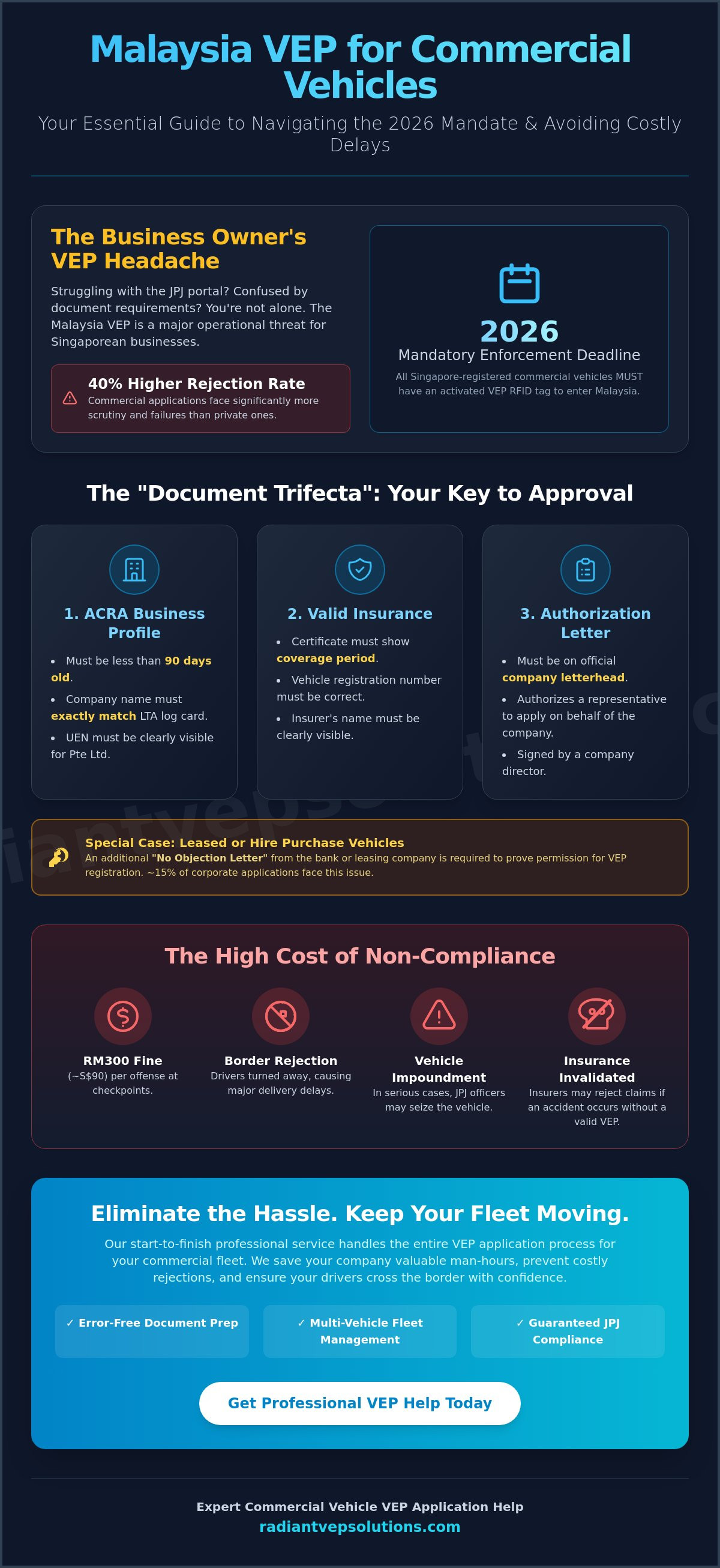
Ignoring the VEP requirement is a recipe for operational disaster. Malaysian authorities have already begun issuing a RM300 fine (approximately S$90) for non-compliance at the checkpoints. It's not just about the financial penalty. Drivers risk being turned back at the border or, in extreme cases, having their vehicles impounded by JPJ officers. For a Singaporean business, a single day of lost transport can cost thousands in missed contracts and damaged client trust. Beyond the immediate fines, an invalid VEP status can jeopardize your corporate insurance. If an accident occurs in Malaysia and your VEP isn't active, your insurer may have grounds to reject the claim, leaving your company to shoulder the full liability.
2026 Enforcement Updates for SG Businesses
The rollout for heavy vehicles and corporate fleets is moving into a high-pressure phase. JPJ has updated its portal interface to accommodate corporate accounts, but the system remains notoriously difficult to navigate for those managing multiple vehicles. By 2026, every vehicle class must have an activated RFID tag. While the initial enforcement began on October 1, 2024, the transition period is ending. Our team provides the commercial vehicle vep application help necessary to manage these portal changes. We ensure your RFID tags are registered, installed, and activated correctly before your drivers reach the Tuas or Causeway gantries, removing the hassle from your daily operations.
Essential Documents for Company-Registered VEP Applications
Applying for a commercial VEP isn't as simple as a personal application. You need what we call the Document Trifecta: a fresh ACRA Business Profile, valid Insurance, and a formal Letter of Authorization. Missing even one detail leads to a 100% rejection rate from the Jabatan Pengangkutan Jalan (JPJ). If you're feeling overwhelmed, our commercial vehicle vep application help ensures your paperwork is perfect before submission.
The ACRA Business Profile Requirement
JPJ requires an ACRA Business Profile that's less than 90 days old. A standard printout from six months ago won't work. The name on your LTA vehicle log card must match the entity name on the ACRA profile exactly. For Private Limited (Pte Ltd) companies, ensure the UEN is clearly visible. Sole proprietorships must show the owner's details clearly to prove the link between the individual and the business asset. If there's a discrepancy of even one character, the system will flag it as a mismatch and halt your progress.
Handling Leased or Hire Purchase Vehicles
If your van or lorry is under a hire purchase agreement with a bank like UOB or DBS, or a corporate lease, you don't technically own the vehicle on paper. You'll need an additional No Objection Letter from the financing institution. This document confirms the bank allows the vehicle to be registered for a Malaysian VEP. Without this, the application will stall during the manual verification phase. We've seen roughly 15% of corporate applications fail simply because the user uploaded a standard log card without the bank's supporting letter.
Drafting the Perfect Letter of Authorization
This document is non-negotiable for company-owned fleets. It must be on official company letterhead and include the UEN, the vehicle plate number, and the specific driver's NRIC or Passport number. If your company has multiple rotating drivers, you should list the primary drivers or issue a generalized authorization that covers your authorized staff. This letter of authorization serves as a legal bridge between the corporate owner and the active driver.
Common scanning mistakes often lead to automatic rejections. To avoid the headache of a resubmission, follow these rules:
- No Blurry Photos: Use a flatbed scanner instead of a phone camera whenever possible to ensure clarity.
- Full Borders: Ensure all four corners of the document are visible in the scan; cropped edges are a common reason for 24-hour rejection notices.
- File Size: Keep files under 2MB while maintaining high resolution to avoid upload errors on the VEP portal.
- Legibility: If a human can't read the insurance expiry date or the engine number, the JPJ verification team will definitely reject it.
Our specialists have handled over 5,000 applications, and we know that precise documentation is the only way to bypass the frustration of the VEP portal. Don't let a blurry scan or an outdated ACRA profile delay your business operations.
Private vs. Commercial VEP: Understanding the Key Differences
Choosing the wrong category in the VEP portal is the fastest way to get your application stuck in "Pending" status for weeks. Private vehicle applications focus on the individual owner's NRIC and LTA log card. Commercial applications are more rigorous. They require your ACRA Business Profile and a clear link between the vehicle and your company entity. If you're struggling with these technical hurdles, getting professional commercial vehicle vep application help can prevent your fleet from being grounded at the border.
The cost for the VEP RFID tag is S$35, and it's valid for five years. However, the workflow for commercial fleets involves extra steps. You must upload a clear copy of your commercial insurance certificate. This document must specifically state that coverage extends to West Malaysia. If your insurance doesn't clearly reflect this, the JPJ system will flag your application as incomplete. We've seen hundreds of SG business owners lose time because they didn't verify their insurance terms before hitting submit.
VEP for PHV and Z10/Z11 Registered Cars
PHV drivers often fall into a grey area that causes massive confusion. Even if you drive a standard sedan, its Z10 or Z11 registration marks it as a commercial vehicle. Malaysia's JPJ requires these drivers to provide proof of their Vocational License (PDVL or TDVL) during the application. It's not just about the car; it's about the driver's legal right to operate it for profit.
If you're a Grab driver using a rented or fleet-managed car, don't start the application alone. You need a specific Letter of Authorization (LOA) from your rental company. Follow these steps to avoid rejection:
- Request the latest LTA log card and LOA from your fleet manager.
- Ensure your commercial insurance covers "Hire and Reward" activities in Malaysia.
- Upload your PDVL/TDVL in the 'Driver Information' section of the portal.
Corporate Fleet vs. Individual Business Owners
Managing VEP for a single van is easy, but managing ten is a logistical headache. We recommend using a single corporate account rather than individual driver accounts. This approach centralizes your records, making it easier to track expiry dates and renewals. It also ensures your JPJ records match your ACRA status, which is vital for tax auditing and claiming business expenses in Singapore.
The "Company" status in the JPJ database offers better long-term stability for your business. It allows for easier transfer of VEP tags if you change drivers, provided the vehicle remains under the same UEN. Using commercial vehicle vep application help ensures your corporate account is set up correctly from day one, saving you from the "Mixed Use" trap where private documentation is incorrectly used for business-registered assets.
Managing Fleet VEP Applications Without the Administrative Headache
Managing a fleet of 10 or 50 vehicles requires more than just a spreadsheet. Most SG businesses struggle because they treat each van as a separate task. This leads to missed expiry dates and potential fines. A centralized tracking system is vital for operational continuity. We recommend using a digital dashboard to monitor every vehicle's status in real-time. This prevents the S$150 fines that occur when a single truck slips through the cracks.
The 'One Login' strategy is the most efficient way to handle 5+ vehicles. Instead of juggling multiple accounts, consolidate your entire fleet under one corporate profile. This simplifies the commercial vehicle vep application help process by allowing one administrator to oversee all renewals. If your company faces issues with staff turnover, you might encounter 'forgotten passwords' or defunct email addresses linked to old accounts. Our specialists recover these accounts daily, often resolving access issues within 24 hours that would otherwise take weeks of correspondence with authorities.
- Centralized Expiry Alerts: Set notifications 60 days before any tag expires.
- Audit Trails: Maintain records of which driver is assigned to which RFID tag.
- Email Recovery: We assist in migrating VEP accounts from personal staff emails to a generic company address (e.g., fleet@company.com).
Streamlining the Collection Process
You don't have to send every individual driver to a VEP Collection Centre in Singapore. This wastes valuable man-hours and fuel. Instead, appoint an 'Authorised Representative' to handle group appointments. One person can collect tags for an entire fleet in a single visit. For businesses with 15 or more vehicles, Radiant VEP provides on-site installation services. We come to your warehouse or office, ensuring your trucks stay on the road and remain productive while we handle the technical setup.
Deregistration and Vehicle Turnover
Selling a company vehicle requires immediate action. You must deregister the VEP because RFID tags are permanently tied to the specific chassis and license plate. You cannot simply peel off a tag and stick it on a new van. If you fail to deregister, the new owner's toll charges might still be billed to your company account. Radiant VEP recently managed a bulk deregistration for a local logistics firm upgrading 12 vans. We completed the entire process in under 48 hours, ensuring no overlapping costs or legal liabilities during the fleet transition. This commercial vehicle vep application help ensures your records stay clean during every buy-sell cycle.
Don't let paperwork slow down your logistics. Get expert help for your fleet VEP today and keep your business moving across the border.
Expert Commercial VEP Application Help in Singapore
Radiant VEP Solutions provides a "Start-to-Finish" promise that removes the administrative burden from your business operations. Managing a fleet is demanding enough without the added stress of navigating foreign transport portals. Our team handles every step, from the initial JPJ account creation to the final RFID tag activation. By outsourcing these tasks, your company saves significant man-hours that would otherwise be spent on data entry and troubleshooting. We've seen that DIY attempts often lead to rejected applications due to minor document errors, costing businesses both time and potential cross-border revenue.
Our specialized support is particularly valuable for complex corporate structures. If your vehicles are under leasing agreements or owned by subsidiary companies, the documentation requirements become much more stringent. We know exactly which ACRA business profiles, authorization letters, and insurance certificates are needed to secure approval. This expert commercial vehicle vep application help ensures that your fleet remains compliant without your staff needing to become experts in Malaysian transport regulations. We bridge the gap between Singaporean corporate records and Malaysian system requirements seamlessly.
Why Choose Radiant for Your Business Fleet?
We bring a proven track record to the table, having completed over 5,000 successful applications for Singaporean drivers and businesses. Our pricing model is built on transparency. You'll receive a flat-fee quote with no hidden corporate surcharges or "expedited" fees. Efficiency is our priority. Our dedicated WhatsApp support channel offers rapid troubleshooting, so you're never left waiting for a generic email response. We provide the direct, human communication that busy logistics managers rely on to keep their operations running smoothly.
Take the Hassle Out of Your Next Border Crossing
Before sending your drivers toward the Causeway or Tuas Second Link, run through a final compliance check. Ensure the physical RFID tag is not only fixed but also activated in the portal. It's also vital to confirm that your Touch 'n Go eWallet is correctly linked to your VEP account. This link is what allows for seamless toll payments and identifies your vehicle at the border. A quick check of the eWallet balance can prevent unnecessary delays at the gantry.
The process is simple: upload your documents, let us handle the submission, and follow our guidance for tag installation. Don't let paperwork stall your logistics. Book your commercial VEP consultation with Radiant today and experience a stress-free commercial vehicle vep application help service designed for the Singaporean business community.
Streamline Your Fleet’s Cross-Border Operations Today
Navigating the 2026 Malaysia VEP requirements doesn't have to be a logistical nightmare for your Singapore business. Understanding the distinct document needs for company-registered vehicles is vital to avoiding delays at the border. Managing multiple applications internally often leads to administrative headaches that pull your team away from their core tasks. By outsourcing the process, you ensure every van, truck, and car in your fleet meets the latest regulations without the stress of trial and error.
Stop letting paperwork slow you down. Radiant VEP Solutions has processed over 5,000 applications and has been featured on CNA and The Straits Times for our efficient, reliable service. We provide the expert commercial vehicle vep application help required to navigate complex registration portals and document verification. Our specialists offer start-to-finish guidance, handling every step so your business stays compliant and your drivers stay on the move. It's the fastest way to secure your fleet's future access to Malaysia.
Get Expert Help With Your Commercial VEP Application Now
Your business deserves a smooth transition into the new mandate. Let's get your applications approved so you can focus on what you do best.
Frequently Asked Questions
Do I need a separate VEP for every commercial vehicle in my fleet?
Yes, you must apply for a separate VEP for every single commercial vehicle in your fleet. Each vehicle is linked to a unique RFID tag and cannot share registration details with another unit. For companies managing 10 or more vehicles, organizing logbooks and UEN documents early prevents unnecessary delays. Our team provides commercial vehicle vep application help to streamline this high-volume registration process efficiently.
What happens if my company-registered vehicle doesn't have a VEP by the 2026 deadline?
You risk being denied entry into Malaysia or facing a fine of up to RM2,000 if your vehicle lacks a VEP by the enforcement deadline. The Malaysian Ministry of Transport has stated that enforcement will be strict for all foreign-registered vehicles. Missing this requirement could disrupt your delivery schedules and logistics operations. We recommend completing your application at least 3 months before the deadline to avoid the last-minute rush.
Can a staff member drive a company car to Malaysia if the VEP is in the company's name?
Yes, any authorized employee can drive the company vehicle into Malaysia once the VEP is activated. The VEP is tied to the vehicle's chassis and registration number, not a specific driver's name. Ensure your staff carries a copy of the vehicle's insurance certificate and an authorization letter. This prevents any confusion at the Johor Bahru checkpoints during routine inspections by JPJ officers.
How do I update the VEP if my company changes its name or UEN?
You must update your vehicle's profile on the official VEP portal immediately if your company changes its name or UEN. If the UEN changes, it's often treated as a transfer of ownership, which may require a completely new application. Failing to update these two key identifiers can lead to your RFID tag being flagged as invalid. Our specialists can handle these administrative updates to ensure your fleet remains compliant without the usual headache.
Is the VEP application process different for light goods vehicles (LGVs) and heavy goods vehicles (HGVs)?
The core application process is identical for both LGVs and HGVs, though you must ensure all weight specifications match your LTA logcard. Both vehicle types require a valid NRIC or Passport of the company representative and the ACRA business profile. Whether you're registering a small van or a 20-footer truck, the goal is to secure the RFID tag. We provide expert commercial vehicle vep application help for all vehicle classes to ensure 100% accuracy.
What should I do if my commercial vehicle's VEP RFID tag is damaged or stolen?
You must log into the VEP portal and report the tag as "Damaged" or "Lost" to deactivate it immediately. Once reported, you can request a replacement RFID tag for a fee, which typically involves a new appointment for installation. Since a damaged tag won't scan at the toll booths, it's vital to fix this before your next trip. We help businesses manage these replacements quickly so their drivers aren't stranded at the border.
How long does the commercial VEP application typically take to process?
Most commercial VEP applications take between 3 and 6 weeks to process from the initial submission to tag activation. This timeline depends on the volume of applications the Malaysian authorities are handling at any given time. To avoid 100% of the stress, submit your documents as soon as your vehicle is registered under your company. We've helped over 5,000 drivers navigate this timeline with our expedited support services.
Can I use the same Touch 'n Go eWallet for multiple company vehicles?
Yes, you can link one Touch 'n Go eWallet to multiple company vehicles to centralize your toll payments. This is a practical solution for fleet managers who want to track transport expenses from a single digital dashboard. Just ensure the eWallet has a sufficient balance for all planned trips across the Causeway or Second Link. It's a simple way to keep your logistics operations running smoothly without managing dozens of individual accounts.
Need help with your Malaysia VEP?
We handle the whole process for Singapore drivers — application, on-site RFID installation, and deregistration.
Related VEP guides
- VEP Application for Company Car Singapore: The Complete 2026 Corporate Guide
- Penalty for No VEP in Malaysia 2026: Fines, Exit Bans, and How to Avoid Them
- Can I Enter Malaysia While My VEP Is Processing? Your 2026 Travel Guide
- Urgent VEP Application Singapore: Get Your Malaysia VEP Approved in 24 Hours (2026)